There’s something about stepping into your 40’s that changes the way you see yourself—and the world.
Not in a dramatic, overnight way… but in a slow and holy shift. It’s like God gently peels back the layers of who you thought you had to be, so you can finally grow into who He always designed you to be.
If you’re in that season right now, or you’re entering it, here are five truths the 40’s tend to teach us—especially as women of faith.
1. People Pleasing
I used to think…
If everyone around me was happy, then I was doing something right. I thought my value came from how well I could meet everyone else’s needs and if I put their needs above my own then I was being a good person.
What I know now…
God didn’t create me to be the peacekeeper of the world. For so many years I believed that my job was to smooth every rough edge, calm every emotion, absorb every conflict, and stretch myself thin so no one else ever felt disappointed or upset. But somewhere along the way, I realized that keeping the peace and making peace are not the same thing—and God did not call me to be a peacekeeper, He called me to be a peacemaker.
A peacekeeper avoids tension at any cost. A peacemaker invites honesty, healing, and truth. One hides hurt to keep everyone comfortable. The other brings things into the light so that relationships can actually repair and grow. Peacekeeping looks gentle on the outside, but it slowly breaks you on the inside. Peacemaking may look messy at first, but it leads to wholeness.
Loving others does not mean sacrificing my God-given identity or bending myself beyond recognition. Choosing myself isn’t betrayal. Setting boundaries isn’t cruelty. Saying “no” isn’t unchristian—sometimes it’s the most Christ-like thing I can do.
I’ve learned that true joy doesn’t come from constantly managing the emotions of others. It comes from pleasing God, being aligned with His will for my life, and showing up as the woman He created—not the woman others demand.
When peace requires me to disappear, it’s not God’s peace.
2. Control
I used to think…
If I planned hard enough, anticipated every outcome, and held everything together with my bare hands, I could prevent people from being disappointed and life from falling apart.
What I know now…
I am not God—thank goodness. For years I tried to carry the weight of other people’s decisions on my back, as if I could steer their lives or protect them from their own choices just by worrying hard enough, praying hard enough, or trying to hold everything together. But I’ve learned, with tears and time, that I am not responsible for the decisions other people make—even when those decisions are painful, destructive, or confusing.
I cannot control how someone else chooses to live their life.
I cannot force someone to be healthy, wise, faithful, honest, or kind.
I cannot make someone treat me—and the people I love—the way they should.
Their choices are their choices.
My choices are my choices.
And those two things are not the same.
There was a season many years ago when someone close to me was making deeply damaging decisions. I prayed and cried and begged God to show me what to do—how to fix it, how to save them, how to make it stop. In the middle of that heartbreak, I felt a gentle truth settle into my spirit: my faith journey is not anyone else’s. The path God asks me to walk, the choices I am responsible for, the obedience He expects from me—that belongs to me alone. And their journey belongs to them.
I can love someone and still step back.
I can pray for someone and still let go.
I can care deeply and still refuse to be crushed under a weight that isn’t mine to carry.
God does not expect me to control anyone’s life—not even out of “good intentions.” He simply asks me to be faithful with my own.
Life becomes softer when I stop gripping people’s choices with white knuckles and surrender them to the One who actually has the power to change hearts. I’ve learned to open my hands instead of clench them, to pray instead of panic, and to rest in the steady truth that Jesus holds every story, every season, and every soul—including mine.
Control is exhausting.
Trust is freeing.
And letting go doesn’t mean giving up—it means giving it to God.
3. Listening to Your Body (especially with chronic illness or autoimmune challenges)
I used to think…
Rest was weakness. I pushed through pain, fatigue, and flare-ups because I didn’t want to seem lazy or dramatic. I ignored my body because I didn’t want to inconvenience anyone.
What I know now…
My body is a temple—not a machine. For so many years I pushed myself past the point of exhaustion because I didn’t want to be seen as weak, dramatic, or irresponsible. Before I ever had a diagnosis, I had people close to me make comments that made me feel guilty for slowing down or not being able to keep up. They decided that I was lazy because they couldn’t see the battle happening inside my body. And the heartbreaking thing is that it often takes a medical diagnosis before people finally “allow” you to rest—as if we need permission to care for the body God entrusted to us.
But now I know better.
I know my body.
I know when something is wrong.
I know when I need rest—not because I want it, but because my body begs for it.
And truthfully, I wish my body worked like everyone else’s. I wish I could push through without consequences, bounce back quickly, and live without calculating energy costs. No one with autoimmune or chronic illness chooses fatigue or pain. We’re not resting because we’re lazy—we’re resting because we’re fighting.
God is not whispering, “Do more.”
He is whispering, “Take care of what I gave you.”
Rest is not quitting.
Slowing down is not failure.
Listening to my body is not optional—it’s obedience.
People who don’t understand chronic illness may still misunderstand my pace, my limits, or my need for downtime. Their opinions might sting, but I don’t have to take them to heart. I answer to God, not to people who don’t know the private battles He has called me to walk through.
And this has taught me something important: to be patient, empathetic, and gentle with others too. Just because someone looks fine doesn’t mean they are fine. You never know what God has placed on somebody else’s road—physically, emotionally, mentally, or spiritually.
So I honor my health.
I honor my limits.
I honor the body God gave me—even if other people don’t understand.
Because I would rather please God and protect the temple He created than run myself into the ground for the comfort or expectations of others.

4. Trusting My Intuition / God-Given Voice
I used to think…
Everyone else knew better than I did. My voice felt small, and I doubted my own discernment. I looked outward for validation instead of upward.
What I know now…
That tug in my spirit? That sense of knowing? That’s the Holy Spirit. I didn’t always understand that. For many, many years I doubted my intuition—my God-given inner voice. Even when something felt deeply wrong, I was easily talked out of it. I assumed other people knew better than I did. I gave more weight to outside opinions than to the voice God placed within me.
Looking back, I can see why. I spent years in environments where my instincts were questioned, minimized, twisted, or dismissed. Emotional manipulation slowly trained me to distrust myself. Gaslighting made me believe I was “too sensitive,” “too dramatic,” or “misreading things.” And when other people joined the criticism—without knowing the truth of the situation—it felt like confirmation that I had no right to my own discernment.
When enough voices tell you you’re wrong, you start to silence your own.
But God never meant for me to live that way.
Over time, and through healing, I’ve learned that the nudge in my heart, the uneasiness that won’t settle, the peace that suddenly lifts, the whisper of warning or reassurance—that is not anxiety or paranoia. That is discernment. That is the Holy Spirit.
Now, I’m learning to honor that inner voice instead of handing my wisdom over to people who don’t have to live with the consequences of my decisions.
I don’t need permission to trust what God is showing me.
I don’t need outside validation to recognize when something is off.
I don’t need a majority vote to obey the Spirit.
When something doesn’t sit right in my soul, I pay attention.
When peace leaves, I listen.
When clarity comes, I receive it.
Discernment is not a coincidence.
It’s a gift.
It’s protection.
It’s guidance.
It’s God.
And what I know now is this: the Holy Spirit didn’t give me intuition just to ignore it. He gave it to me so I could walk confidently, make wise decisions, protect my heart, and move in the direction He has for me—even if no one else understands.
I will not silence the voice God placed in me again.
5. Boundaries
I used to think…
If I really loved someone, I would always be available, always flexible, always forgiving, always push aside my voice to keep the peace, and always willing to put my needs to the bottom of the list.
What I know now…
Boundaries don’t push people away—they teach people how to love us in ways that don’t harm us. For so long, I believed that if I really loved someone, I should give without limit, forgive without accountability, and stay endlessly available no matter the cost to my heart, my health, or my peace. I confused self-sacrifice with holiness and exhaustion with loyalty. I thought being a “good Christian woman” meant having no limits.
But the truth is, even Jesus had boundaries.
Jesus rested.
Jesus withdrew from crowds.
Jesus said “no.”
Jesus walked away from people who were not willing to receive Him.
Jesus didn’t heal every person in every town He visited—not because He didn’t care, but because obedience has limits and purpose.
If the Son of God did not overextend Himself in the name of compassion, then why should I?
One of the most healing truths I’ve learned in this area is something Lysa TerKeurst has said many times:
Forgiveness is required. Reconciliation is not.
God commands me to forgive—not to subject myself to repeated harm. Forgiveness releases my heart. Reconciliation requires two hearts willing to change.
Boundaries are not barriers to love; they are containers for healthy love. Without them, some people will take and take and take until there is nothing left—not out of evil necessarily, but because they have no limit unless one is set. Boundaries protect what is holy within me—my peace, my calling, my health, and the woman God is shaping me into.
Not everyone will like my boundaries.
Some may push back or accuse or misunderstand.
But that doesn’t make boundaries wrong—it makes them necessary.
I have learned that:
- Boundaries do not mean I love less.
- Boundaries mean I refuse to love in a way that destroys me.
- Boundaries mean I trust God more than I fear disappointment, conflict, or misunderstanding.
Now, instead of giving everything I have until I have nothing left, I give what God asks me to give—no more, no less. My heart is softer because it is protected. My compassion is deeper because it is sustainable. My relationships are healthier because they are built on mutual respect rather than depletion.
Boundaries don’t keep people out.
They keep love safe.
And they allow me to show up—not resentful, not worn down, not erased—but present, whole, and rooted in who God says I am.
The 40’s feel like coming home to yourself. Not the version of yourself the world demanded, not the version you shape-shifted into for survival or acceptance, but the woman God handcrafted—strong, tender, wise, steady, and grounded.
But getting here hasn’t been easy.
Learning these truths—about people pleasing, control, chronic illness, intuition, and boundaries—has not been a comfortable journey. Sometimes it’s been incredibly painful. Sometimes it has involved loss. Sometimes it has meant walking away, letting go, grieving what could’ve been, or accepting what never will be. And there were seasons when learning these lessons left me feeling completely lost.
If you’re in that season right now—the “in between,” the painful middle, the place where you’re trying to trust God but don’t understand what He’s doing—I see you. You are not weak. You are not failing. You are not forgotten. Sometimes becoming the woman God designed you to be requires walking through things you never asked for.
If you feel lost, keep holding onto Jesus.
Open your Bible even when it feels like you have nothing left to give.
Trust that He is working even when you can’t yet see the blueprint.
One story that has helped me more than almost anything else is the story of Hagar in Genesis chapter 16. She was mistreated and pushed away. She ran into the wilderness wounded and alone because of the choices of others. And in that desolate place, God met her—not when she was strong, not when she was thriving, but when she was broken and hurting. He didn’t scold her. He didn’t shame her. He saw her. He comforted her and gave her hope for the future.
Hagar gave God the name El Roi — “The God who sees me.”
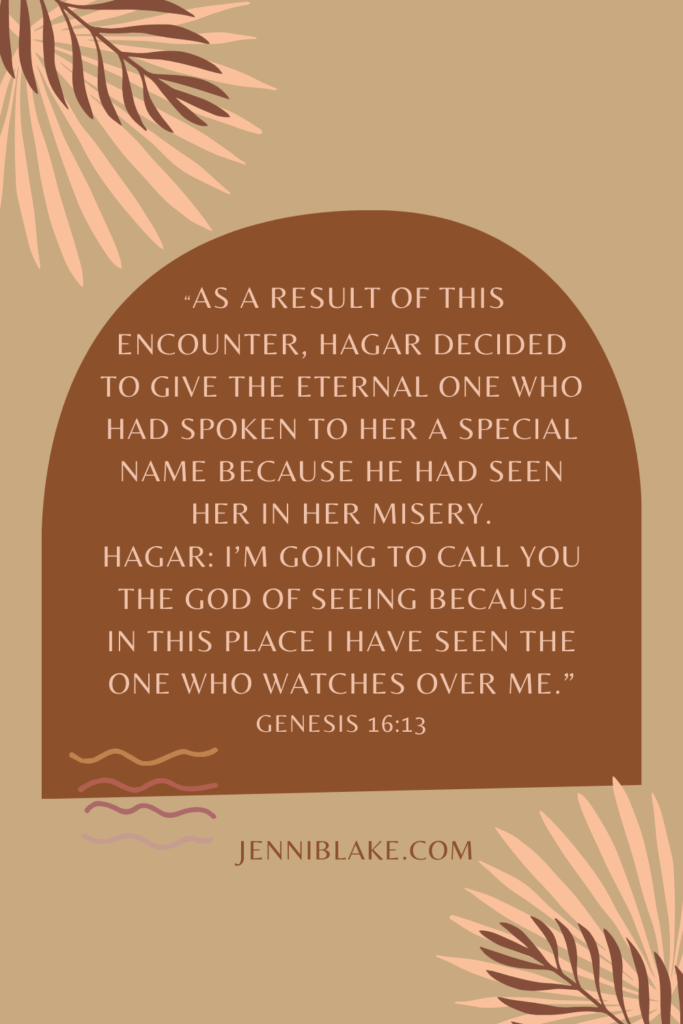
And maybe you need that reminder too:
Even when life has been unfair, even when someone else’s choices have hurt you deeply, even when you feel abandoned, misunderstood, or invisible—God sees you. He hears your cries. He knows the whole story. And He is not absent in your wilderness.
I used to think aging meant losing something.
What I know now is that it means gaining everything that finally matters.
Gaining wisdom.
Gaining confidence.
Gaining peace.
Gaining identity rooted in Christ instead of approval.
Gaining the freedom to live the life God actually intended—not the one others demanded.
If you’re somewhere in this journey, I hope you feel seen and supported. And I hope you know this:
You are not behind.
You are not failing.
You are becoming.
Even when it’s slow.
Even when it’s messy.
Even when it hurts.
And God is right here in the midst of it all—guiding you, growing you, and holding every piece of your story with care.