In 2009, my father was diagnosed with a very rare autoimmune disorder called Chronic Inflammatory Demyelinating Polyneuropathy (CIDP). CIDP is a neurological autoimmune disease where the body’s immune system mistakenly attacks the protective covering around the nerves, called the myelin sheath. When that protective layer becomes damaged, the nerves cannot communicate properly with the body, leading to weakness, pain, numbness, balance issues, and extreme fatigue.
Some days my father could barely move. At times he was completely bedridden. Other days, after receiving his treatments, he could manage to walk short distances with a cane. Those treatments were what he simply called his “infusions.” I later learned they were intravenous infusions—medications delivered directly into the bloodstream through an IV to help calm the immune system and slow the damage being done to his nerves. The treatments helped temporarily, but they were incredibly expensive, which meant consistency in care was difficult.
At the time, very few people had even heard of CIDP. There was little public awareness, very little discussion surrounding autoimmune disorders, and almost no representation in mainstream media. We often found ourselves trying to explain what the disease even was before we could explain what it was doing to his body. Nowadays, there is thankfully much more awareness surrounding autoimmune disorders and CIDP specifically. There are even commercials and campaigns bringing visibility to conditions that once felt invisible. While awareness does not erase the suffering, it does help people feel less alone and more understood than they once were.
Watching my father live with CIDP taught me something I would not fully understand until years later: autoimmune disease is unpredictable, invisible, and deeply misunderstood by people who have never experienced it. From the outside, symptoms can look like laziness, inconsistency, lack of ambition, or exaggeration. But those who live with chronic illness—or love someone who does—know the truth. There are battles happening inside the body that no one else can see.
But even before my father’s diagnosis, my own body had already begun showing signs that something was not quite right.
In 2007, about six months after delivering my daughter, I was diagnosed with postpartum thyroiditis—an inflammation of the thyroid that can happen after pregnancy when the immune system attacks the thyroid gland. What initially seemed temporary eventually developed into hypothyroidism, a condition where the thyroid no longer produces enough hormones to properly regulate the body’s energy, metabolism, and many other essential functions.
Over time, I also developed a goiter, which is an enlargement of the thyroid gland, along with thyroid nodules. Since then, I have taken Synthroid daily, a thyroid hormone replacement medication used to help restore normal hormone levels when the thyroid can no longer function properly on its own.
At the time, I did not fully connect these diagnoses to the larger picture of autoimmune dysfunction. I simply kept moving forward because that is what so many women are conditioned to do.
Then, in 2010, just one year after my father’s CIDP diagnosis, he was diagnosed with Stage IV Hodgkin’s Lymphoma, a cancer that affects the lymphatic system, which is part of the body’s immune system. He endured chemotherapy, radiation, and eventually a bone marrow transplant—a procedure where damaged bone marrow is replaced with healthy stem cells in hopes of rebuilding the body’s ability to produce healthy blood cells.
We hoped so desperately those treatments would give him more time, but they did not bring the outcome we prayed for. Looking back now, I sometimes wonder if the immune-suppressing treatments required for CIDP played a role in triggering the lymphoma. Many autoimmune treatments work by intentionally lowering or suppressing the immune system to stop it from attacking the body, but those same treatments can sometimes increase the risk of certain cancers, including lymphoma.
After more than a year of fighting both CIDP and Hodgkin’s Lymphoma, my father passed away.
Losing him changed the way I listened to my body.
For years, my body had been trying to get my attention. I was exhausted in ways that sleep could not fix. I had strange pains that seemed to move throughout my body without explanation. But whenever I tried to talk about it, people around me dismissed it. I was told it was stress. Motherhood. Hormones. Being overwhelmed from raising three young children. Some people implied I was simply tired because I lacked discipline or ambition.
And when enough people repeat those things to you, you begin questioning yourself.
But deep down, I knew something was wrong.
A side note that I now believe is important: from approximately 2008 through 2020, I was also living through an incredible amount of emotional trauma and chronic stress. Those years profoundly impacted my nervous system, emotional health, and eventually my physical health as well. Over time, I developed Complex PTSD (CPTSD), which can occur after prolonged or repeated trauma.
In the book The Body Keeps the Score by Dr. Bessel van der Kolk, the connection between trauma, the nervous system, and physical illness is explored in depth. While trauma alone does not “cause” autoimmune disease, many researchers and medical professionals now acknowledge that prolonged stress and unresolved trauma can significantly impact immune system function and inflammation within the body.
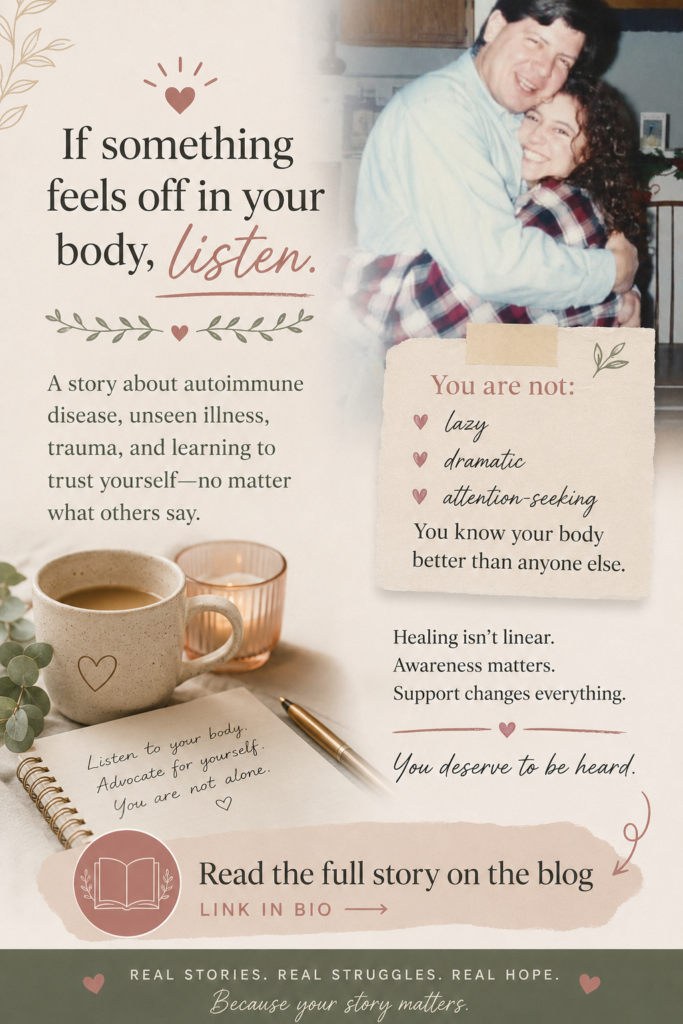
I was likely already genetically predisposed to autoimmune issues because of my father’s medical history. But looking back, I cannot ignore how deeply those emotionally traumatic years seemed to exacerbate my symptoms and overall health struggles. My body was carrying grief, stress, survival mode, and inflammation all at the same time.
In the fall of 2011, while still in my early thirties, I finally went to the doctor to discuss the pain and fatigue I had been experiencing. Even then, the symptoms were brushed aside. I was told it was probably Fibromyalgia—a chronic condition associated with widespread pain, fatigue, sleep disturbances, and sensitivity throughout the body—but that I was “too young” for an official diagnosis. I was prescribed Cymbalta, a medication commonly used for nerve pain, depression, and Fibromyalgia symptoms, and then sent on my way.
I took it for six months and gained nearly fifty pounds during that time. I honestly do not even remember whether it helped the pain because I became so emotionally overwhelmed by the rapid changes in my body. Eventually, I stopped taking it altogether.
But the symptoms never left.
The strange pains continued. The exhaustion continued. The feeling that something inside my body was “off” continued rising back to the surface no matter how many times I tried to explain it away or convince myself that everyone else must be right.
What I know now—and what I wish more people understood—is this:
You know your body better than anyone else.
Not your family.
Not your coworkers.
Not the people who call you dramatic, lazy, emotional, unmotivated, or attention-seeking.
Not even the people who love you but refuse to truly listen.
If your body keeps sounding the alarm, pay attention.
There is grief in looking back and realizing how often I ignored myself because I wanted to be believed, accepted, or understood by others. But there is also gratitude. Gratitude that I eventually learned to trust myself. Gratitude that my father’s journey opened my eyes to the importance of advocating for answers. Gratitude for the people who chose compassion over judgment.
Because the truth is, support matters deeply when you are navigating unexplained illness. Find the people who will listen without dismissing you. Find the people who will sit with you in uncertainty instead of convincing you that it is all in your head. Find the people who will encourage you to keep searching for answers when you are tired of fighting.
And above all: advocate, advocate, advocate for yourself.
You are not weak for knowing something is wrong.
You are not dramatic for wanting answers.
You are not lazy because your body functions differently than someone else’s.
Listen to your body, even when others refuse to. It often knows the truth long before anyone else does.